
Business
Revenue Streams: The Lifeblood of Every Business

Published
21 seconds agoon
By
Realty Fact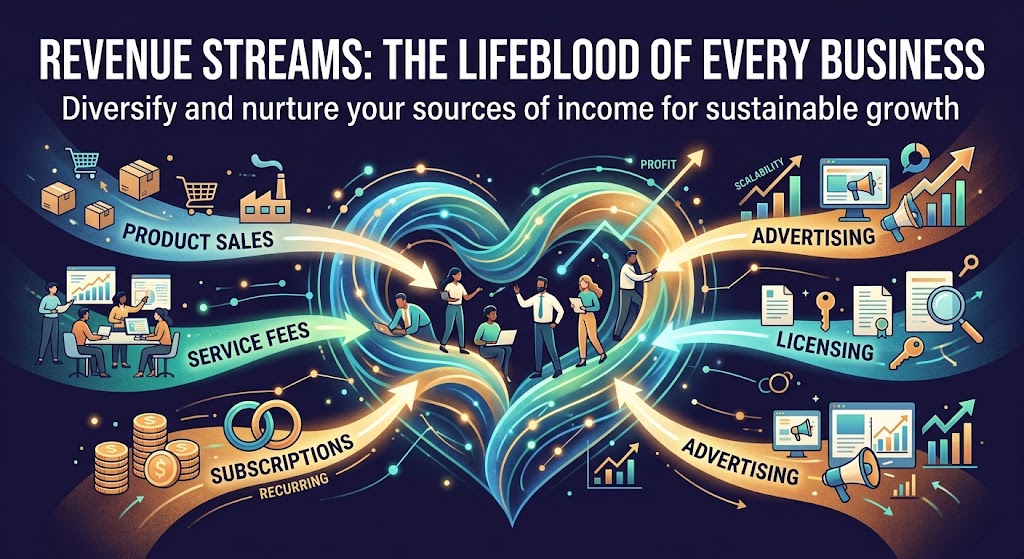
Table of Contents
ToggleIntroduction
Every business, no matter its size or industry, depends on one fundamental element to survive and grow: revenue. But revenue doesn’t appear from a single source—it flows in through what are known as revenue streams. Understanding what revenue streams are, how they differ, and how to build and diversify them is essential for anyone running or planning a business.
This article explores the concept of revenue streams, the most common types, why diversification matters, and how businesses can create sustainable income sources.
What Is a Revenue Stream?
A revenue stream is a distinct source of income that a business generates from selling goods, services, or other value to customers. A company can have one revenue stream or many, depending on its business model.
For example:
- A coffee shop might earn primarily from in-store drink sales—a single revenue stream.
- A software company might earn from subscriptions, one-time license fees, consulting services, and advertising—multiple revenue streams.
The key distinction is that each stream represents a separate channel through which money enters the business.
Why Revenue Streams Matter
Revenue streams are more than just numbers on a balance sheet. They determine:
- Stability – Multiple streams reduce dependence on any single income source.
- Growth potential – New streams open new markets and customer segments.
- Risk management – If one stream dries up, others can keep the business afloat.
- Valuation – Investors often value companies with diversified, recurring revenue more highly.
A business with a single revenue stream is like a table with one leg—stable until something knocks it over. Diversification builds resilience.
Common Types of Revenue Streams
Businesses typically generate revenue through one or more of the following models:
1. Transaction-Based Revenue
Income from one-time sales of products or services.
- Example: A retail store selling clothing, or a consultant charging a flat fee for a project.
2. Recurring Revenue
Income that repeats on a regular schedule, such as weekly, monthly, or annually.
- Example: Netflix subscriptions, gym memberships, or SaaS software plans.
- Recurring revenue is highly prized because it’s predictable and scalable.
3. Service-Based Revenue
Income from providing expertise, labor, or ongoing support.
- Example: Legal fees, IT support contracts, or tutoring services.
4. Advertising Revenue
Income from selling space or attention to advertisers.
- Example: Google, Facebook, and most free media platforms.
5. Licensing and Franchising
Income from allowing others to use your brand, technology, or intellectual property.
- Example: McDonald’s franchising, or a musician licensing a song for a commercial.
6. Commission-Based Revenue
Income from facilitating a transaction between two parties.
- Example: Real estate agents, affiliate marketers, or ride-sharing platforms.
7. Interest and Investment Revenue
Income from financial assets or lending.
- Example: Banks earning interest on loans, or a company earning returns on invested capital.
8. Subscription and Membership Fees
A subset of recurring revenue, often tied to access rather than ownership.
- Example: Amazon Prime, Patreon, or professional associations.
Direct vs. Indirect Revenue Streams
Revenue streams can also be classified by how directly they relate to the core business:
- Direct revenue streams come from the primary product or service (e.g., a bakery selling bread).
- Indirect revenue streams come from secondary activities (e.g., the same bakery selling advertising space on its packaging or hosting baking classes).
Both can be valuable, but indirect streams often require different capabilities and should be evaluated carefully.
The Power of Diversification
Relying on a single revenue stream is risky. Market shifts, economic downturns, or changing consumer preferences can wipe out an entire income source overnight. Consider how many businesses collapsed during the COVID-19 pandemic because they depended entirely on in-person sales.
Diversification offers several benefits:
- Reduced risk – No single failure can sink the business.
- Increased customer lifetime value – Different streams can serve the same customer in different ways.
- Better use of assets – Existing resources, audiences, or infrastructure can be monetized in new ways.
- Higher enterprise value – Investors reward predictable, multi-stream revenue.
However, diversification isn’t always wise. Spreading too thin can dilute focus, strain resources, and confuse your brand. The goal is strategic diversification—adding streams that complement your core strengths.
How to Identify New Revenue Streams
Here are practical steps to uncover new income opportunities:
- Audit your current streams – List every source of income and its contribution to total revenue.
- Understand your customers – What else do they need that you could provide?
- Leverage existing assets – Can your data, audience, expertise, or infrastructure be monetized differently?
- Study adjacent markets – Who else serves your customers, and how?
- Test small – Pilot new streams before committing major resources.
- Measure and iterate – Track performance and double down on what works.
Real-World Examples
- Apple earns from hardware sales, the App Store, iCloud subscriptions, Apple Music, and advertising—a masterclass in diversification.
- Amazon generates revenue from retail, Prime subscriptions, AWS cloud services, and advertising.
- A local bakery might add catering, cooking classes, and wholesale supply to its retail counter sales.
In each case, the business built streams that reinforced its core value proposition rather than distracting from it.
Conclusion
Revenue streams are the arteries through which cash flows into a business. Understanding the different types—transactional, recurring, service-based, advertising, licensing, and more—helps entrepreneurs and managers design smarter business models. While a single stream can work, diversification offers stability, growth, and resilience. The most successful companies don’t just find one way to make money; they build several, each feeding and strengthening the others.
Whether you’re launching a startup or running an established enterprise, regularly reviewing and refining your revenue streams isn’t optional—it’s essential to long-term survival and success.