
Business
Latest Fintech Startup News: The Trends, Funding Deals, and Innovations Shaping 2026

Published
6 hours agoon
By
Realty Fact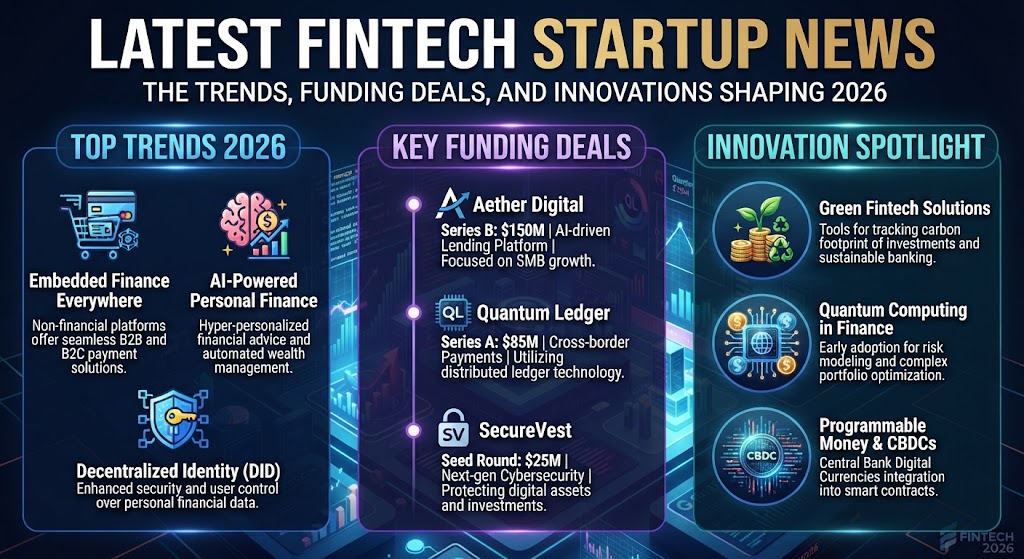
Fintech startups are entering a more selective phase of growth. Investors are still putting significant capital into financial technology, but the focus has shifted toward companies that can demonstrate strong products, sustainable business models, financial infrastructure, and practical uses of artificial intelligence.
Recent fintech startup news shows a sector increasingly centered on AI-powered finance, payment infrastructure, digital banking, stablecoins, wealth management, and automated financial operations. At the same time, larger funding rounds and acquisitions suggest that investors are becoming more selective about which fintech businesses receive capital.
For entrepreneurs, investors, financial professionals, and technology watchers, these developments offer useful clues about where the industry may be heading next.
Table of Contents
ToggleFintech Funding Is Rising, but Investors Are Becoming More Selective
One of the clearest themes in recent fintech news is the difference between total investment and deal volume.
Crunchbase reported that fintech startups raised approximately $28.6 billion globally during the first half of 2026, representing a 22.7% year-over-year increase. However, the number of deals declined by more than 25%. That suggests investors are concentrating capital into fewer companies rather than spreading smaller checks across a larger number of startups.
KPMG reported an even broader view of the market. Its H1 2026 fintech report found that global fintech investment across venture capital, private equity, and M&A reached $103.1 billion, compared with $72.2 billion in the second half of 2025. The United States accounted for $80.8 billion of that investment.
The takeaway for startups is straightforward: having a fintech idea is no longer enough. Investors increasingly want evidence that a company can scale, solve a meaningful financial problem, manage regulatory requirements, and build sustainable revenue.
Artificial Intelligence Is Becoming a Major Fintech Investment Theme
AI is no longer limited to chatbots and customer-service automation. Financial technology startups are applying AI to credit decisions, fraud detection, financial management, underwriting, compliance, investment services, and back-office operations.
KPMG reported that AI-focused fintech companies attracted $21.4 billion in deal value during H1 2026 across venture capital, private equity, and
One example is Plaid, which has been expanding beyond its traditional role in connecting financial accounts. The company recently introduced updated credit-risk products, including an AI-powered model that uses cash-flow information to assess borrowers. The approach is designed to provide lenders with additional information beyond traditional credit scores.
This trend matters because access to financial data can allow fintech companies to create more personalized financial products. However, AI also introduces challenges involving privacy, explainability, security, bias, and regulatory compliance.
Why AI Matters to Fintech Startups
Startups are particularly interested in AI because it can potentially help them:
- Automate repetitive financial operations
- Detect suspicious transactions
- Improve customer support
- Analyze cash-flow information
- Assist with underwriting
- Personalize financial recommendations
- Reduce administrative workloads
- Identify potential fraud patterns
The strongest businesses are likely to be those using AI to solve a specific financial problem rather than simply adding an AI feature for marketing purposes.
Payments Infrastructure Continues to Attract Capital
Payment technology remains one of the strongest areas within fintech.
Businesses increasingly expect payments to be fast, secure, programmable, and capable of operating across borders. That creates opportunities for startups building the infrastructure behind transactions rather than consumer-facing banking applications.
KPMG reported that the payments sector attracted $44.2 billion in fintech investment during H1 2026, making it one of the industry’s most significant investment categories.
Recent startup activity also illustrates this interest. Funding trackers have reported investment in companies developing money-movement infrastructure, dollar-payment platforms, and payment systems designed for specific industries.
The opportunity extends beyond simply processing card payments. Modern payment startups are exploring areas such as:
- Cross-border transfers
- Instant payments
- Embedded payments
- Business-to-business transactions
- Virtual accounts
- Stablecoin payments
- Fraud prevention
- Payment reconciliation
For businesses, better payment infrastructure can reduce friction while improving the speed and visibility of financial transactions.
Stablecoins Are Moving Further Into the Fintech Conversation
Stablecoins continue to receive attention from fintech companies because they can potentially connect digital assets with everyday financial transactions.
Unlike highly volatile cryptocurrencies, stablecoins are generally designed to maintain a relatively stable value against an underlying asset, often a fiat currency. Their potential applications include cross-border payments, settlement, treasury management, and international transfers.
Recent fintech funding activity reflects growing interest in this area. For example, startup funding reports have highlighted companies developing stablecoin-based payment infrastructure and platforms designed to make U.S.-dollar transactions more accessible globally.
The opportunity is significant, but stablecoin businesses still have to deal with regulatory requirements, compliance, liquidity, consumer protection, and the practical challenge of integrating digital assets with existing financial systems.
For startups, the most compelling opportunities may therefore come from infrastructure that makes digital-asset payments easier for businesses to use rather than from speculative consumer products.
Digital Banking Startups Are Expanding Beyond Traditional Banking
The digital banking model continues to evolve.
Early fintech challengers often focused on basic services such as checking accounts, debit cards, low-cost foreign exchange, and mobile banking. Newer business models are expanding into lending, investing, wealth management, business banking, insurance, and financial planning.
Revolut provides a notable example of how far a fintech company can expand. Reuters reported in October 2026 that the company had reached an estimated private valuation of $115 billion and had around 80 million users globally, while continuing international expansion.
Its growth also demonstrates a broader industry shift: successful fintech companies increasingly want to become full financial platforms rather than remain focused on one product.
That creates both opportunity and risk. Offering more services can increase customer relationships and revenue opportunities, but it also creates greater operational, regulatory, and compliance responsibilities.
Wealth Management Is Becoming More Technology-Driven
Another area attracting fintech investment is digital wealth management.
Consumers increasingly expect investment services to provide simple interfaces, personalized information, and lower barriers to participation. Startups are responding with automated investment platforms, digital financial planning tools, portfolio analytics, and AI-assisted advice.
Recent funding activity has included significant investment in AI-native wealth management businesses. This reflects growing investor interest in technology that can improve how financial professionals and consumers manage assets.
AI could eventually support more parts of the investment process, from analyzing financial information to helping customers understand portfolio risks. However, financial advice involves substantial responsibility, meaning fintech companies must balance automation with transparency and appropriate oversight.
The Biggest Opportunities May Be in Financial Infrastructure
One important development in the latest fintech startup news is the growing importance of infrastructure.
Consumer-facing fintech applications receive considerable attention, but infrastructure companies often solve problems that many financial businesses share. These startups may provide APIs, compliance tools, payment rails, fraud systems, banking infrastructure, data services, or financial automation.
This model can be attractive because one technology platform may serve many banks, lenders, marketplaces, or other fintech companies.
For entrepreneurs considering a fintech startup, infrastructure can therefore be an interesting area to investigate. Instead of competing directly for consumers, a company can potentially build technology that helps other financial businesses operate more efficiently.
Questions Entrepreneurs Should Ask
Before launching a fintech product, founders should consider:
- What financial problem does the product solve?
- Who is willing to pay for the solution?
- What regulations apply to the business model?
- How will customer and financial data be protected?
- Can the technology scale without costs growing at the same rate?
- Does the product provide a meaningful advantage over existing solutions?
These questions can matter as much as the underlying technology.
Fintech M&A Is Reshaping the Competitive Landscape
Funding is only one part of the story. Acquisitions are also influencing fintech.
Recent deal activity has included acquisitions in payments, personal finance, lending, and financial infrastructure. Axios reported several recent fintech transactions, including Stripe’s agreement to acquire small-business lender Parafin and Anchorage’s acquisition of Routable in a corporate-payments move.
Large financial and technology companies can use acquisitions to obtain technology, talent, customers, licenses, or specialized infrastructure more quickly than building everything internally.
For startup founders, this creates another potential path to an exit. A fintech business does not necessarily need to become a massive standalone bank to create significant value. Specialized technology with a strong customer base can also become attractive to larger companies.
What the Latest Fintech Startup News Means for the Future
The fintech market is becoming more mature, but that does not mean innovation is slowing.
Instead, innovation appears to be moving toward more specialized financial problems. AI, payments, digital assets, wealth management, fraud prevention, financial infrastructure, and automated business finance are all attracting attention.
At the same time, investors appear increasingly interested in companies with proven business models rather than startups relying solely on rapid user growth. The decline in deal volume alongside rising investment value is a useful indication of this shift.
For customers, this could mean better financial products and more competition. For businesses, it could mean easier access to payment, lending, and financial-management tools. For entrepreneurs, the opportunity remains significant—but building a fintech company now requires a stronger combination of technology, financial expertise, compliance, and business fundamentals.
Key Takeaways for Businesses and Investors
The current fintech environment can be summarized through several major trends:
- AI is becoming central to financial technology development.
- Payments remain one of the largest fintech investment categories.
- Investors are concentrating capital into fewer, more established opportunities.
- Stablecoins and digital assets continue moving toward practical financial applications.
- Digital banks are expanding into broader financial ecosystems.
- Wealth management is becoming increasingly technology-driven.
- Financial infrastructure remains an important startup opportunity.
- M&A is giving larger companies another way to acquire fintech capabilities.
The most promising fintech companies may not necessarily be the ones with the most complicated technology. They may be the ones that solve expensive, recurring financial problems in a way that customers can understand and regulators can support.
Conclusion
The latest fintech startup news points to a market that is still growing but becoming more disciplined. Investors continue to deploy substantial amounts of capital, while their focus is increasingly directed toward AI, payments, infrastructure, digital assets, wealth management, and businesses with demonstrated potential to scale.
For anyone following the sector, the most useful question is no longer simply which fintech startup raised the most money. A better question is what financial problem is the company solving, and why is its solution likely to matter over the long term?
That perspective can help entrepreneurs identify genuine opportunities, investors evaluate emerging businesses, and companies understand where financial technology is heading next.
Frequently Asked Questions
What is the latest trend in fintech startups?
AI-powered financial services, payment infrastructure, digital banking, stablecoin payments, fraud prevention, and automated financial operations are among the major fintech trends attracting attention in 2026.
Yes. Fintech investment remains substantial, although investors are becoming more selective. Global fintech startups raised $28.6 billion in venture funding during H1 2026, while broader fintech investment across VC, private equity, and M&A reached $103.1 billion during the same period.
Why are investors interested in AI fintech startups?
AI can help financial companies automate operations, analyze financial data, improve fraud detection, support credit decisions, and personalize services. Investors are particularly interested when AI addresses a specific business problem rather than serving as a superficial product feature.
Are stablecoins becoming important for fintech?
Stablecoins are receiving increasing attention for potential applications in cross-border payments, settlement, treasury operations, and digital financial infrastructure. Their wider adoption will depend partly on regulation, compliance, security, and integration with traditional financial systems.
What should entrepreneurs look for when starting a fintech company?
Founders should identify a clear financial problem, understand the applicable regulations, protect customer data, develop a sustainable revenue model, and determine whether their technology offers a meaningful advantage over existing financial products.