
Education
Helonium Meaning: What Is Helonium and Why Is It the Strongest Acid?

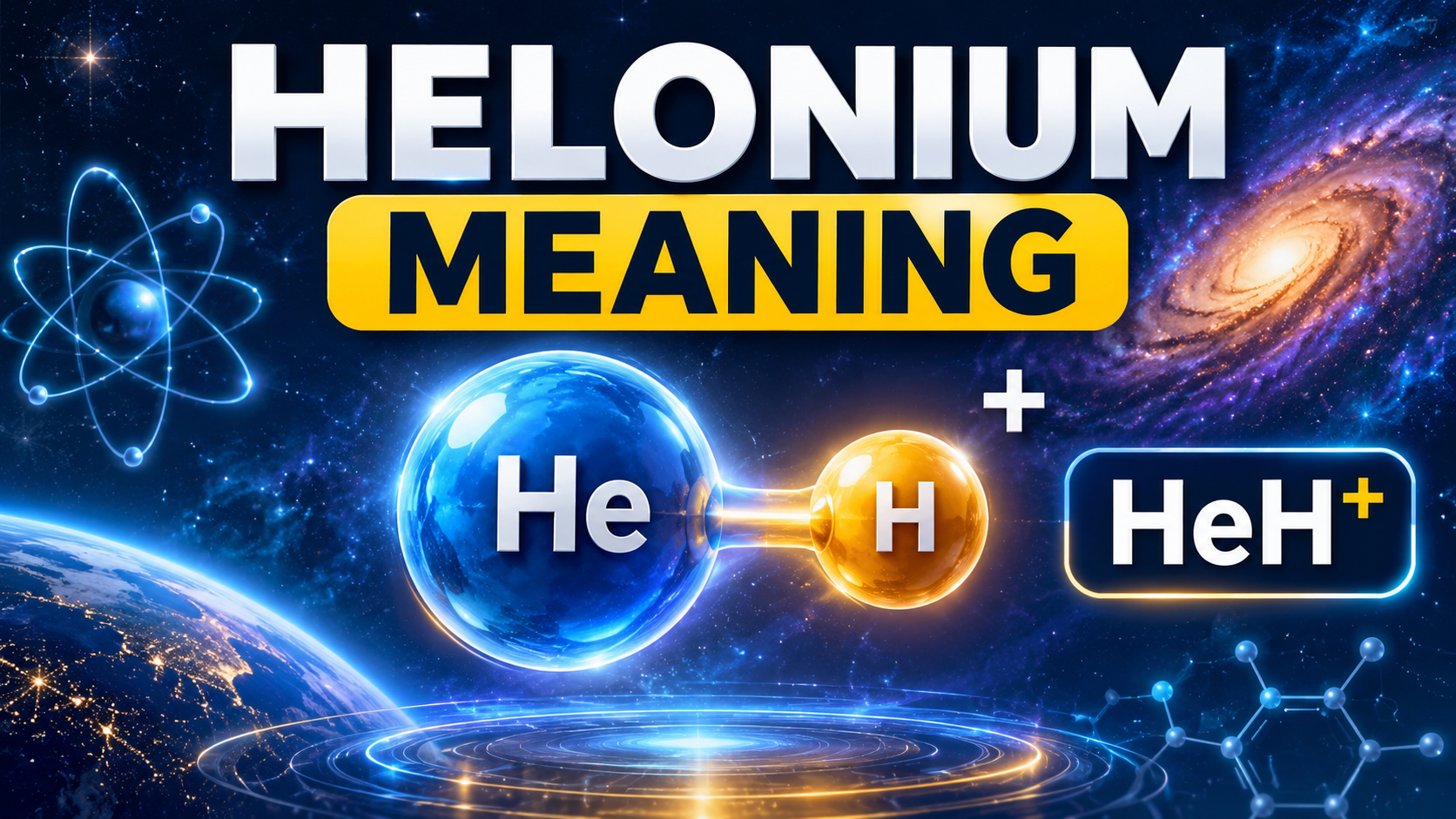
Helonium is the name commonly associated with the helium hydride ion, written as HeH⁺. It is a positively charged molecular ion formed from helium and hydrogen. Unlike ordinary helium, which is a stable noble gas, helonium is highly reactive and has unusual chemical properties.
Helonium is particularly interesting to scientists because it is considered one of the earliest molecular species formed in the universe. It is also known for its exceptional proton-donating ability, making it an important subject in chemistry and astrophysics.
What Is Helonium?
Helonium, also called the helium hydride ion, is a molecular cation consisting of a helium atom bonded to a hydrogen nucleus (proton).
Its chemical formula is HeH⁺, where:
- He: Represents helium.
- H: Represents hydrogen.
- +: Indicates a positive electrical charge.
The ion forms when a helium atom interacts with a proton:
He + H⁺ → HeH⁺
Helo-nium is not a separate chemical element. It is a molecular ion with a unique structure and chemical behavior.
Why Is Helonium Considered the Strongest Acid?
One of the most interesting properties of HeH⁺ is its exceptional acidity. It is often described as the strongest known acid because it has an extremely strong tendency to donate its proton.
Its unusual acidity is related to the weak interaction holding the proton in the helium hydride ion. When another suitable chemical species encounters it, the proton can transfer readily.
However, there is an important distinction: this description refers to its extraordinary gas-phase proton-donating ability. Helonium is not a conventional liquid acid that can be stored in a bottle.
Its theoretical acidity is sometimes discussed using an estimated pKa of approximately −63, but this is not a directly measured ordinary aqueous pKa.
Is Helonium a Real Chemical Element?
No, h-elonium is not an element on the periodic table.
Although its name resembles elements such as helium, lithium, and uranium, it represents a molecular ion rather than an independent element.
Here is the difference:
| Property | Helium | Helonium |
|---|---|---|
| Symbol | He | HeH⁺ |
| Type | Chemical element | Molecular ion |
| Charge | Neutral | +1 |
| Contains hydrogen | No | Yes |
| Chemical behavior | Mostly unreactive | Highly reactive |
| Periodic table | Yes | No |
Helium is a noble gas with atomic number 2, while helonium is a positively charged species containing helium and hydrogen.
Why Is Helonium Important in the Universe?
Helonium has an important connection to the early history of the universe.
After the Big Bang, hydrogen and helium became the main ingredients of the developing cosmos. As the universe expanded and cooled, chemical reactions gradually became possible.
Scientists consider HeH⁺ a leading candidate for the first molecular ion formed in the early universe. Its formation represents an important stage in the development of molecular chemistry.
Helium hydride is therefore valuable for understanding how simple atoms eventually began forming more complex chemical species.
When Was Helonium First Discovered in Space?
Scientists had studied helium hydride in laboratories long before finding evidence of it in space.
In 2019, researchers detected HeH⁺ in the planetary nebula NGC 7027 using NASA’s Stratospheric Observatory for Infrared Astronomy (SOFIA).
The discovery was significant because scientists had predicted that helium hydride should exist in certain astronomical environments. However, detecting its characteristic spectral signature had been difficult.
The observation provided important evidence that HeH⁺ can naturally exist in space and helped strengthen scientific understanding of molecular chemistry in planetary nebulae.
How Is Helonium Different From HeHHe⁺?
Another source of confusion is the chemical formula HeHHe⁺.
Although the names and formulas look similar, these are different molecular species.
- HeH⁺: The helium hydride ion, also known as helonium.
- HeHHe⁺: A different molecular ion containing two helium atoms and one hydrogen atom.
Scientific research has investigated HeHHe⁺ because of its potential importance in infrared spectroscopy and early-universe chemistry.
For example, the research paper A Molecular Candle Where Few Molecules Shine: HeHHe⁺ explores its possible formation, molecular stability, and astronomical significance.
Summary
Helonium refers to the helium hydride ion (HeH⁺), an unusual positively charged molecular species formed from helium and a proton. It is not a chemical element and is known for its exceptional gas-phase acidity.
Its possible role in early-universe chemistry and its astronomical detection in NGC 7027 in 2019 make it an important subject in modern scientific research. Understanding the difference between helium, helonium, and HeHHe⁺ also helps prevent common scientific misconceptions.